Distributed Atomicity and Group Commit
Data Science 310
Boston University
Review: ACID Properties
- A transaction has the following “ACID” properties:
- Atomicity: either all of its changes take effect or none do
- Consistency preservation: its operations take the database from one consistent state to another
- Isolation: it is not affected by and does not affect other concurrent transactions
- Durability: once it completes, its changes survive failures
- We’ll now look at how the DBMS guarantees atomicity and durability.
- ensured by the subsystem responsible for recovery
Atomicity
- In a centralized database, logging and recovery are enough to ensure atomicity.
- if a txn’s commit record makes it to the log, all of its changes will eventually take effect
- if a txn’s commit record isn’t in the log when a crash occurs, none of its changes will remain after recovery
- What about atomicity in a distributed database?
Recall: Distributed Transactions
- A distributed transaction involves data stored at multiple sites.
- One of the sites serves as the coordinator of the transaction.
- The coordinator divides a distributed transaction into subtransactions, each of which executes on one of the sites.
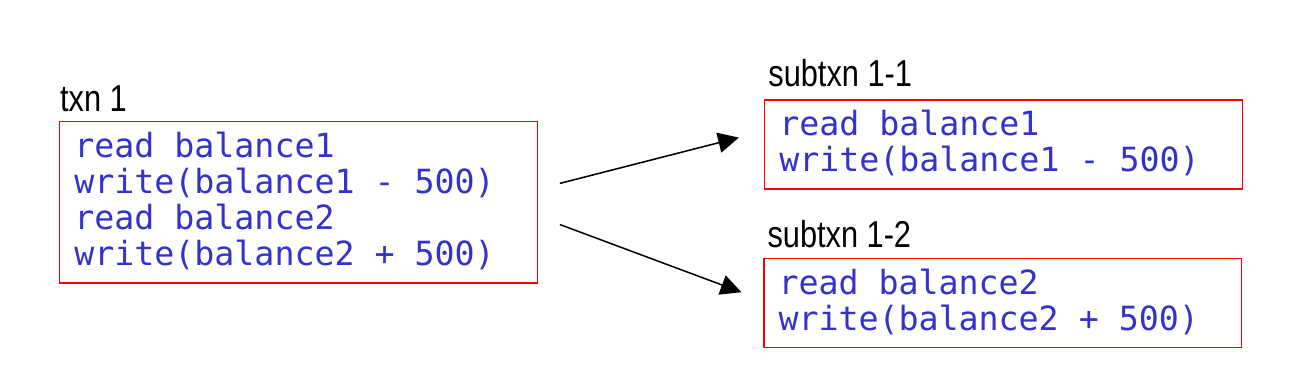
Distributed Atomicity
- In a distributed database:
- each site performs local logging and recovery of its subtxns
- that alone is not enough to ensure atomicity
- The sites must coordinate to ensure that either:
- all of the subtxns are committed, or
- none of them are
Distributed Atomicity (cont.)
- Example of what could go wrong:
- a subtxn at one of the sites deadlocks and is aborted
- before the coordinator of the txn finds out about this, it tells the other sites to commit, and they do so
- Another example:
- the coordinator notifies the other sites that it’s time to commit
- most of the sites commit their subtxns
- one of the sites crashes before committing
Two-Phase Commit (2PC)
- A protocol for deciding whether to commit a distributed txn.
- Basic idea:
- coordinator asks sites if they’re ready to commit
- if a site is ready, it:
- prepares its subtxn – putting it in the ready state
- tells the coordinator it’s ready
- if all sites say they’re ready, all subtxns are committed
- otherwise, all subtxns are aborted (i.e., rolled back)
- Preparing a subtxn means ensuring it can be either committed or rolled back – even after a failure.
- need to at least force all dirty log records for subtxn to disk
- some logging schemes need additional steps
- After saying it’s ready, a site must wait to be told what to do next.
2PC Phase I: Prepare
- When it’s time to commit a distributed txn T, the coordinator:
- force-writes a prepare record for T to its own log
- sends a prepare message to each participating site
- If a site can commit its subtxn, it:
- takes the steps needed to put its txn in the ready state
- force-writes a ready record for T to its log
- sends a ready message for T to the coordinator and waits
- If a site needs to abort its subtxn, it:
- force-writes a do-not-commit record for T to its log
- sends a do-not-commit message for T to the coordinator
- can it abort the subtxn now?
yes – in fact, it may do so before getting the prepare msg!
- Note: we always log a message before sending it to others.
- allows the decision to send the message to survive a crash
2PC Phase II: Commit or Abort
- The coordinator reviews the messages from the sites.
- if it doesn’t hear from a site within some time interval, it assumes a do-not-commit message
- If all sites sent ready messages for T, the coordinator:
- force-writes a commit record for T to its log
- T is now officially committed
- sends commit messages for T to the participating sites
- force-writes a commit record for T to its log
- Otherwise, the coordinator:
- force-writes an abort record for T to its log
- sends abort messages for T to the participating sites
- Each site:
- force-writes the appropriate record (commit or abort) to its log
- commits or aborts its subtxn as instructed
2PC State Transitions
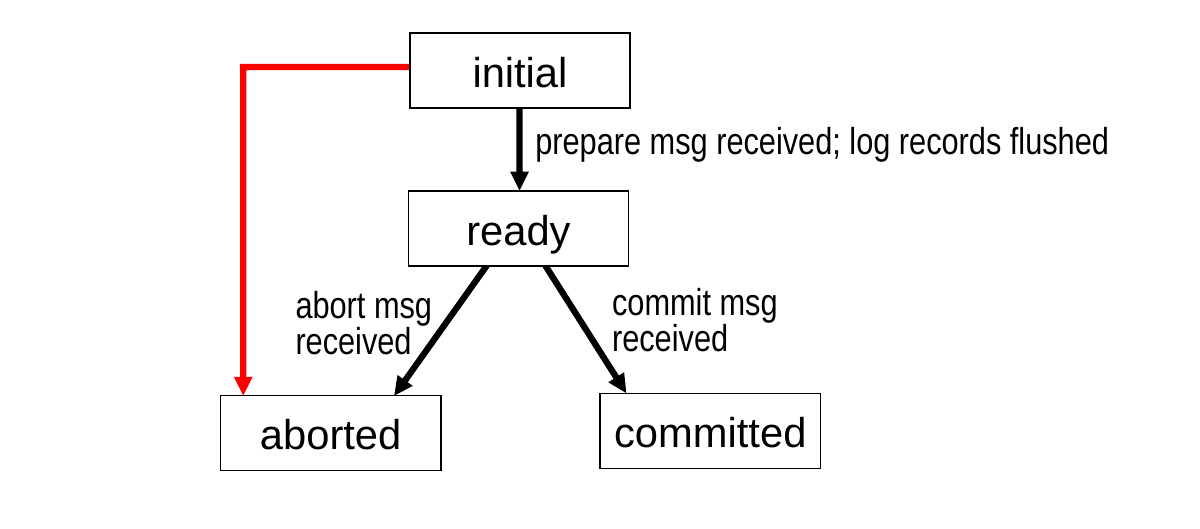
- A subtxn can enter the aborted state from the initial state at any time.
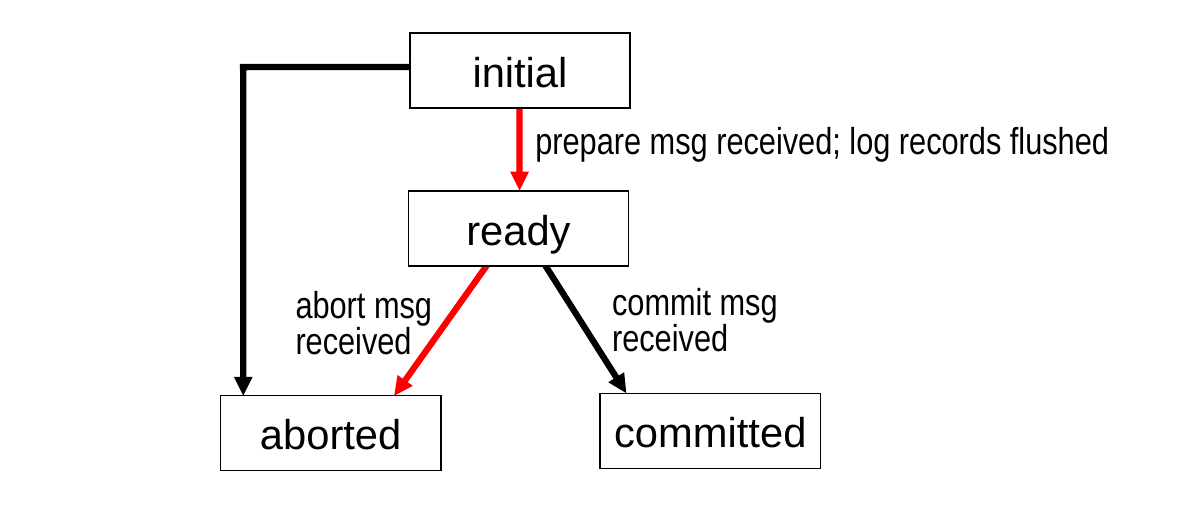
- After entering the ready state, it can only enter the aborted state after receiving an abort message.
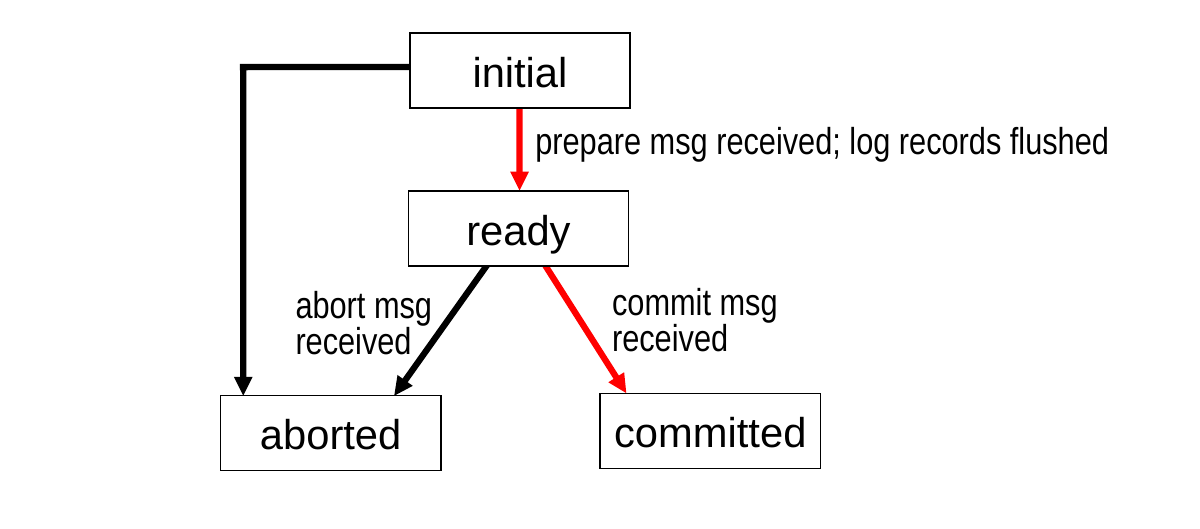
- A subtxn can only enter the committed state from the ready state, and only after receiving a commit message.
Recovery When Using 2PC
- When a site recovers, it decides whether to undo or redo its subtxn for a txn T based on the last record for T in its log.
- Case 1: the last log record for T is a commit record.
- redo the subtxn’s updates as needed
- Case 2: the last log record for T is an abort record.
- undo the subtxn’s updates as needed
- Case 3: the last log record for T is a do-not-commit record.
- undo the subtxn’s updates as needed
- why is this correct?
the site’s do-not-commit vote means T has been or will be aborted
Recovery When Using 2PC (cont.)
- Case 4: the last log record for T is from before 2PC began (e.g., an update record).
- undo the subtxn’s updates as needed
- this works in both of the possible situations:
- 2PC has already completed without hearing from this site
T would have been aborted without this site’s ready msg - 2PC is still going on
the site must abort T now (since it didn’t prepare it before the crash), and then vote do-not-commit if asked
- 2PC has already completed without hearing from this site
- Case 5: the last log record for T is a ready record.
- contact the coordinator (or another site) to determine T’s fate
- why can the site still commit or abort T as needed?
it prepared for either option before it sent the ready message!
- if it can’t reach another site, it must block until it can reach one!
What if the Coordinator Fails?
- The other sites can either:
- wait for the coordinator to recover
- elect a new coordinator
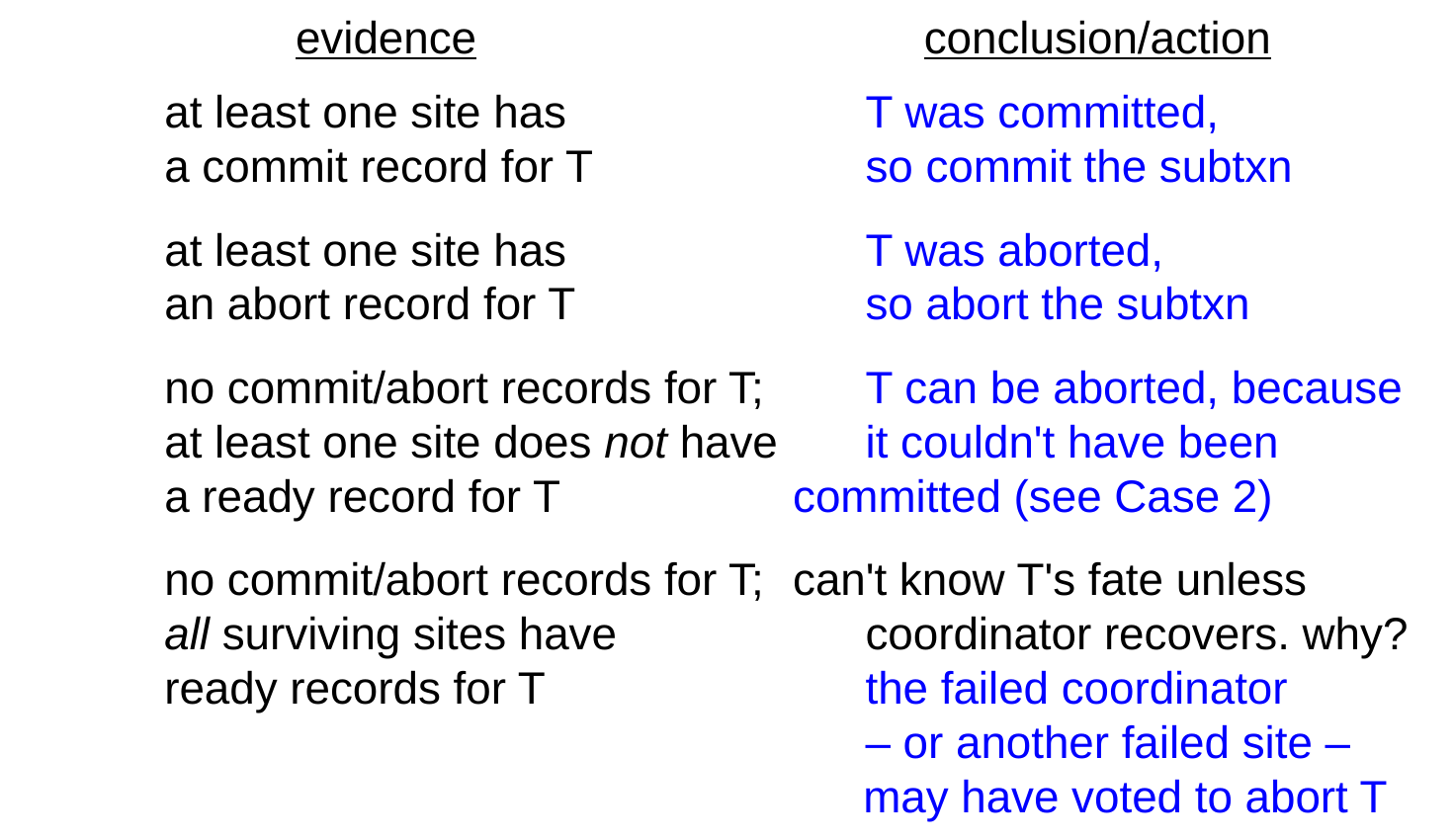
- In the meantime, each site can determine the fate of any current distributed transactions.
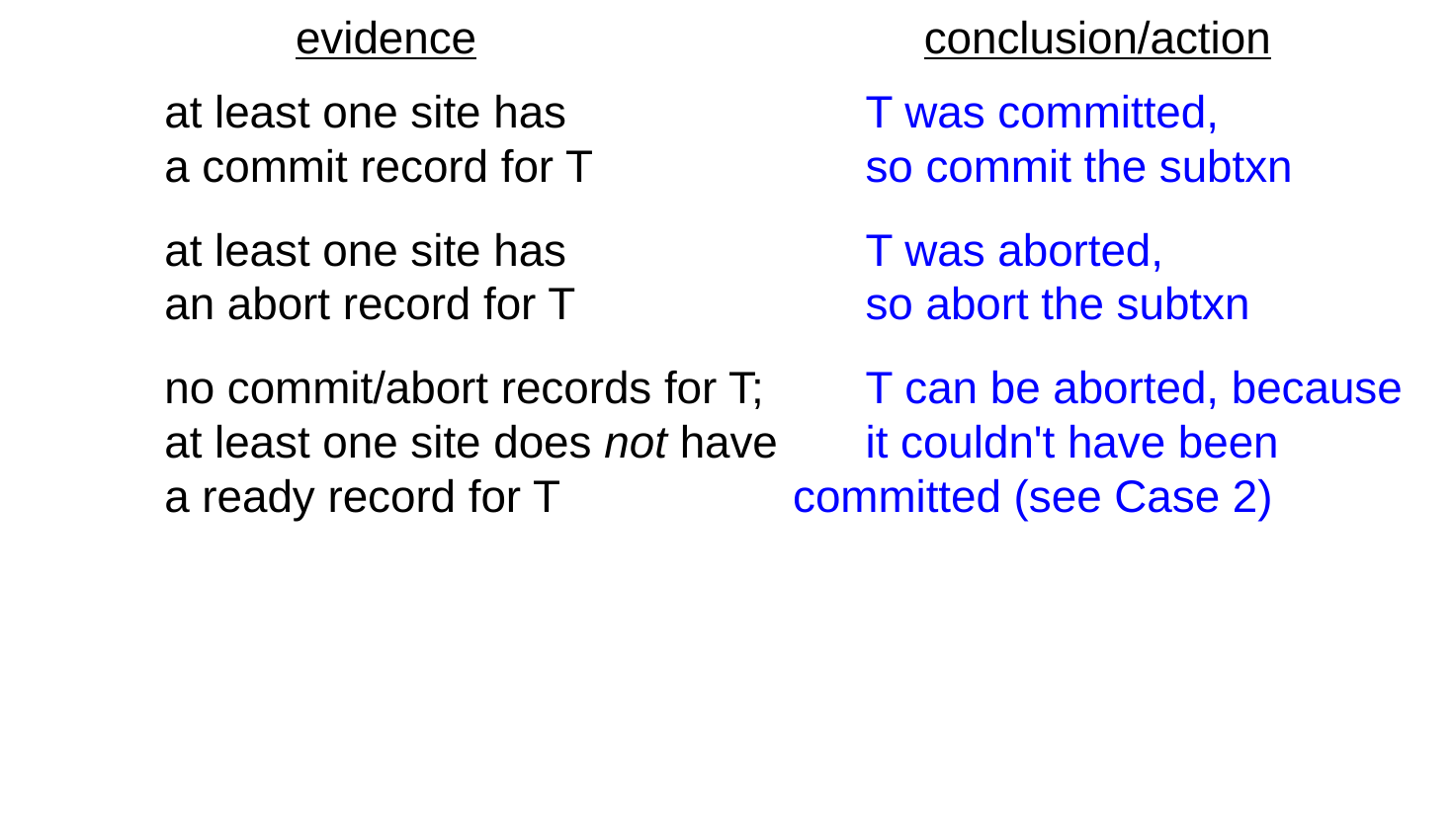
- Case 1: a site has not received a prepare message for txn T
- can abort its subtxn for T
- preferable to waiting for the coordinator to recover, because it allows the T’s fate to be decided
- Case 2: a site has received a prepare message for T, but has not yet sent ready message
- can also abort its subtxn for T now. why?
T couldn’t have been committed without the site’s ready msg.
- can also abort its subtxn for T now. why?
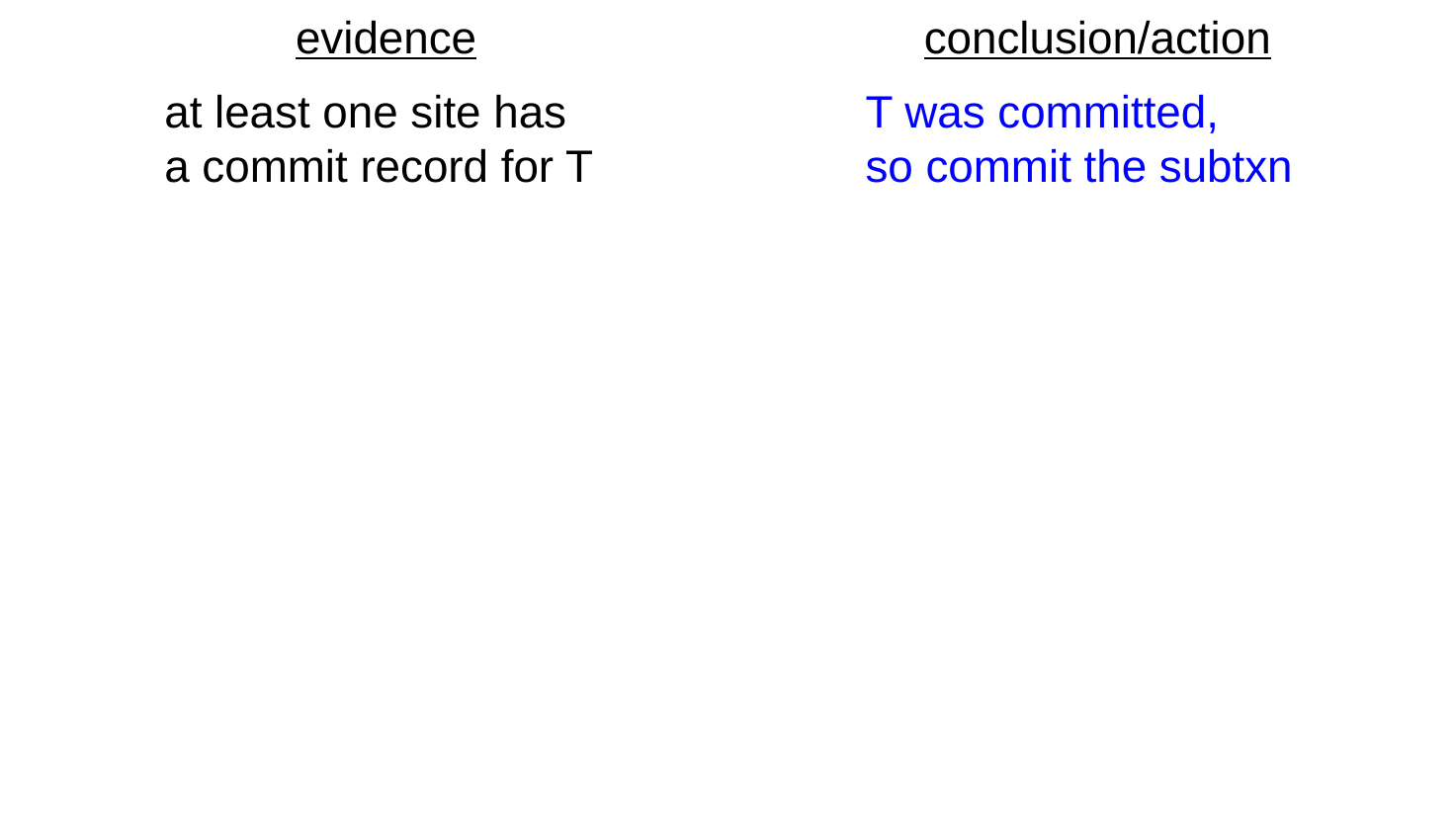
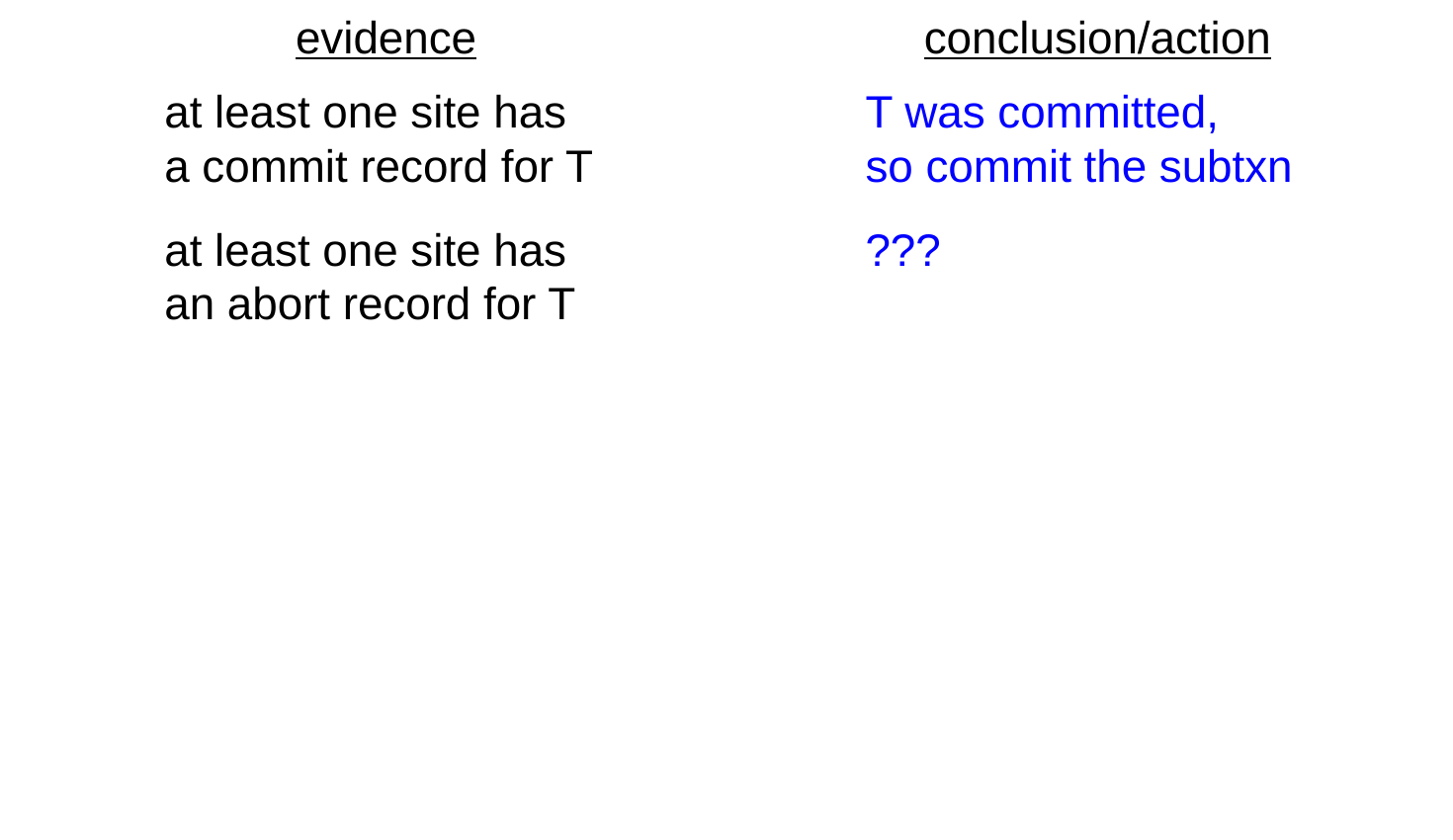
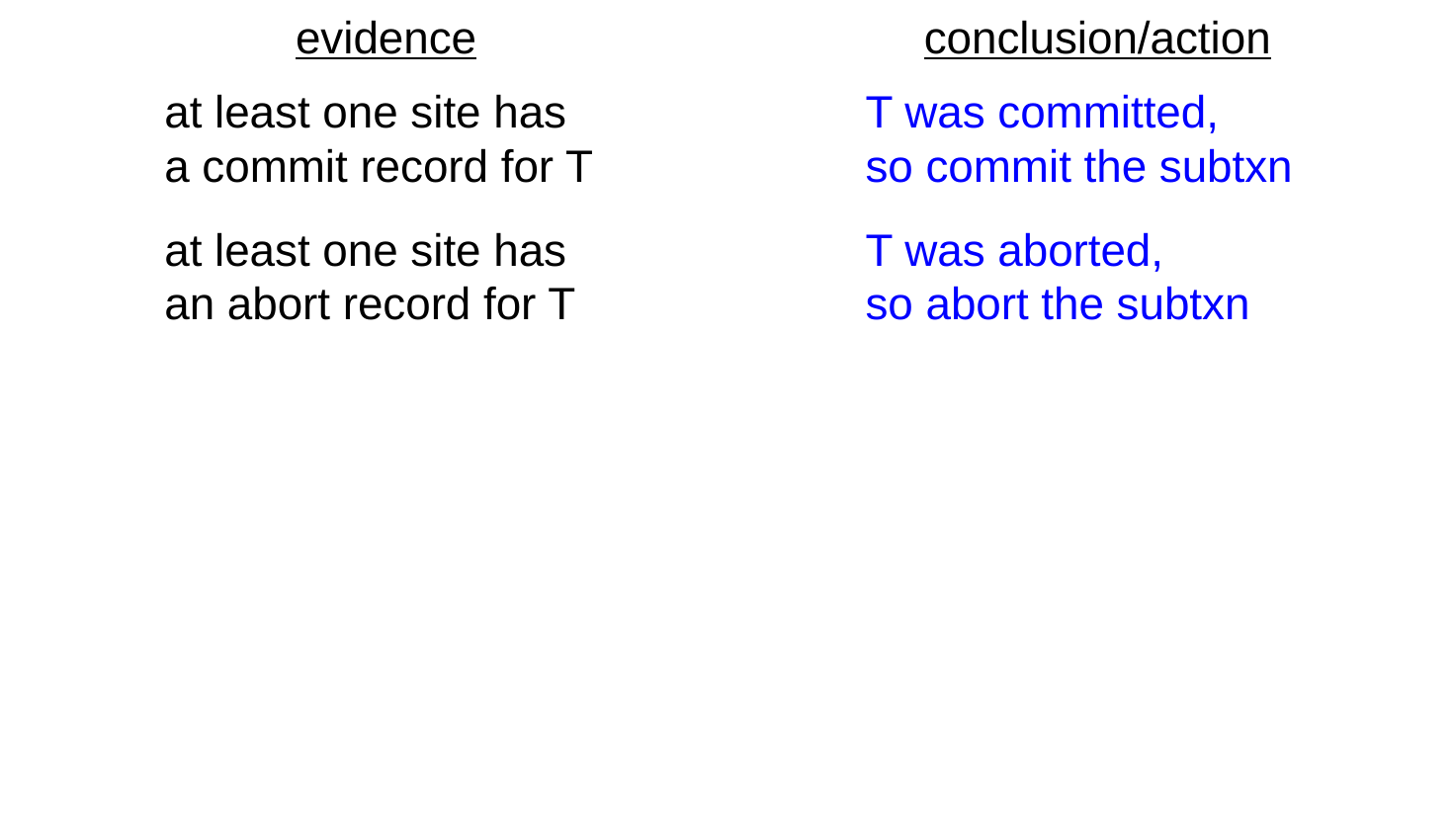
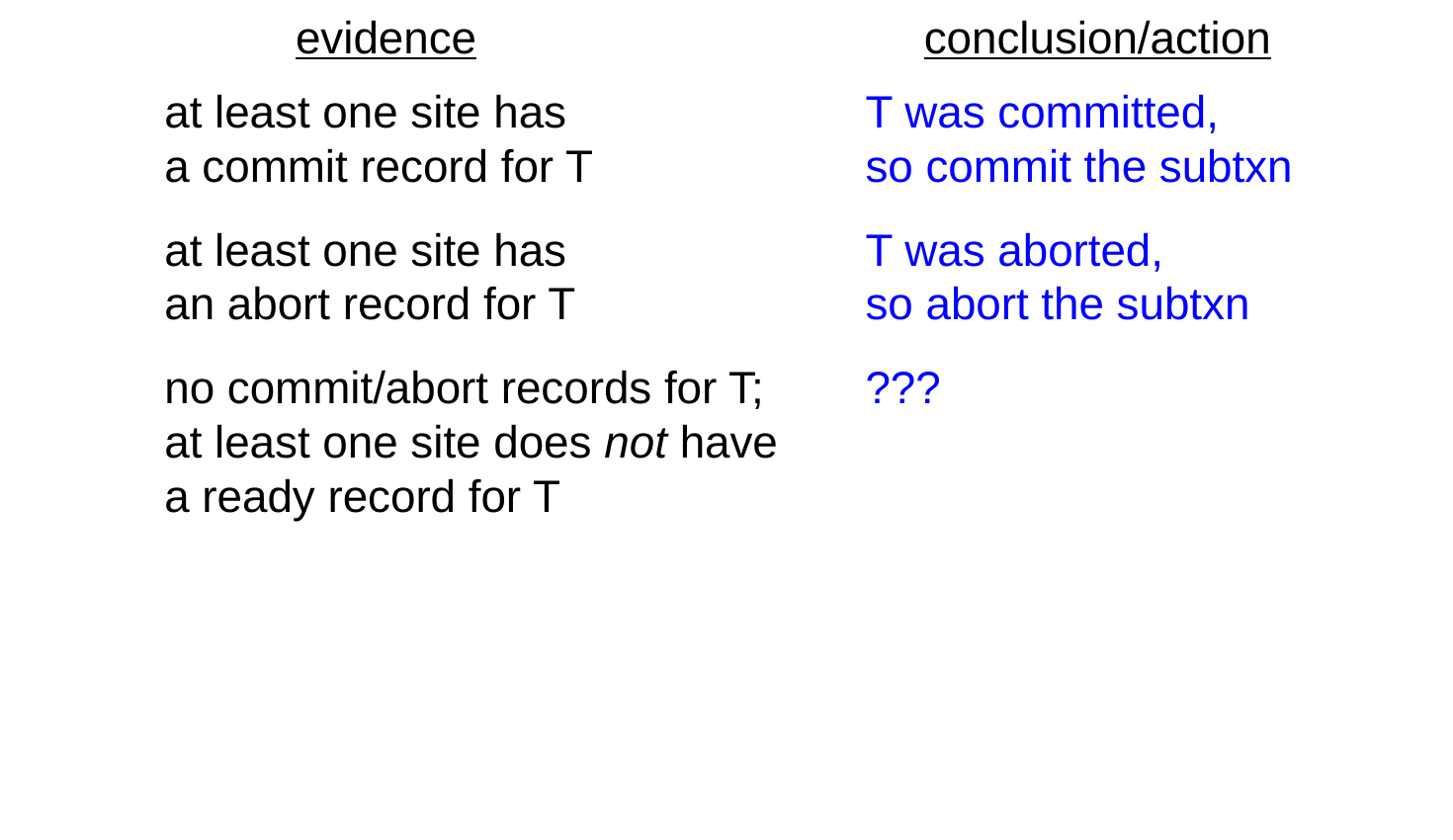
What if the Coordinator Fails? (cont.)
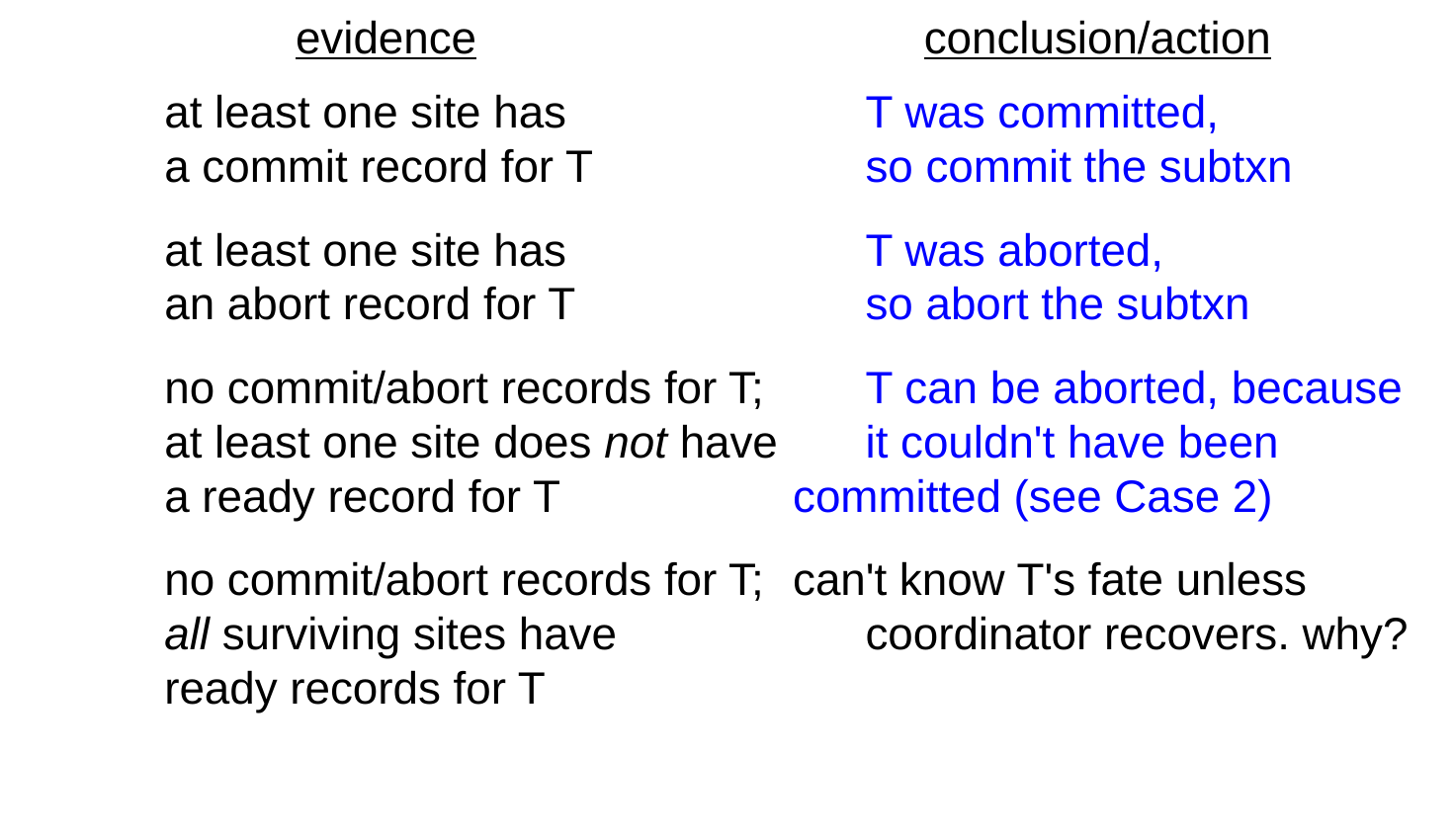
- Case 3: a site sent a ready message for T but didn’t hear back
- poll the other sites to determine T’s fate

2PC Example
- T requires subtxns at sites A, B, C. Site A is the coordinator.
- After the last operation in T, site A:
- sends prepare messages to B and C
- puts its own subtxn in the ready state.
- Sites B and C:
- put their subtxns in the ready state
- send ready messages to A
- Site A:
- writes its commit record (T is now officially committed)
- sends commit messages to B and C
- B writes its commit record.
- C crashes before writing its commit record. What happens?
during recovery, C encounters T’s ready record, so it contacts A and finds out T was committed. C writes a commit record for T, and redoes T as needed.
2PC Phase II: Commit or Abort (cont.)
- Many implementations of 2PC include the following additions:
- a site acknowledges its receipt of the commit/abort message by sending the coordinator an ack message
- once the coordinator receives acks from all sites, it writes an end log record for the transaction
- The acks allow the coordinator to know when it can remove info. about a txn from its in-memory transaction table.
- These additions also allow the coordinator to know whether it should resend the commit/abort messages after recovering from a crash.
Review: Concurrency Control
- Goals: a schedule of actions by concurrent txns should be:
- serializable
- recoverable
- ensure one txn doesn’t commit before another txn whose write it has read
- preventing dirty reads would also guarantee this
- cascadeless:
- prevent dirty reads
- How do the mechanisms that we studied prevent dirty reads?
- locking: use strict locking, holding write locks until commit
- timestamps: set commit bits to false until a writer commits
Logging and Concurrency Control
- To implement either of the concurrency-control mechanisms, we need to answer this question:
- When is a txn really committed?
- Strictly speaking, a transaction T is not committed until its commit log record makes it to disk.
- why?
if there’s a crash before that point, T’s changes will be undone
- why?
- However, for performance reasons, it can be undesirable to force log records to disk (“flush the log”) every time a commit command is received.
Group Commit
- In group commit, the system doesn’t immediately flush the log every time that a commit command is received.
- Instead, the system:
- writes the commit record to the in-memory log buffer
- releases the locks held by the txn or sets the appropriate commit bits to true
- waits to flush the log until some later point in time
- the transaction’s thread/process is put to sleep until the log is flushed
- in the meantime, other transactions may also commit
- Multiple txns may end up having their commit records written to disk at the same time.
- hence the name “group commit”
Impact of Group Commit
- In group commit, it’s still the case that a commit operation is not fully complete until the commit record makes it to disk.
- However, we do release locks/reset commit bits before the commit record makes it to disk.
- As a result, there can be dirty reads while a yet-to-be committed txn is waiting for the log to be flushed.
- Can group commit violate atomicity or durability?
- no, because a txn’s log records are still on disk before its commit operation completes
Impact of Group Commit (cont.)
- Can group commit violate recoverability?
- no, provided that the log records are forced to disk in the order in which they were written
- example: let’s say that we have the in-memory log buffer shown at right
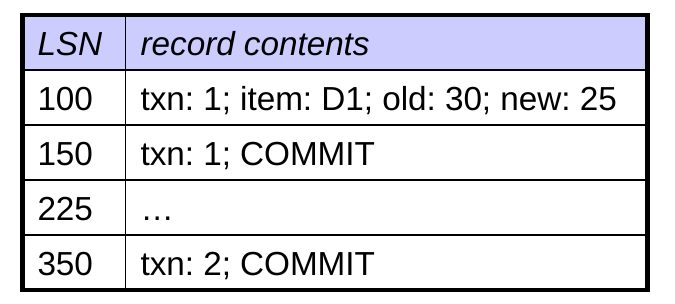
- assume T2 reads D1 after T1 writes it
- the database will be in an unrecoverable state if the system crashes with only T2’s commit record on disk
- why? T1 must be rolled back, but T2 can’t be
- but if the log records are forced to disk in order, this can never happen!
- if T2’s commit record is on disk, T1’s must be, too
Impact of Group Commit (cont.)
- Can group commit lead to a cascading rollback?
- no.
- if a dirty read occurs, the writer of the dirty data has already chosen to commit and will not subsequently choose to abort
- if a crash occurs, the reader of the dirty data would already have been rolled back as part of recovery – whether or not it performed the dirty read